

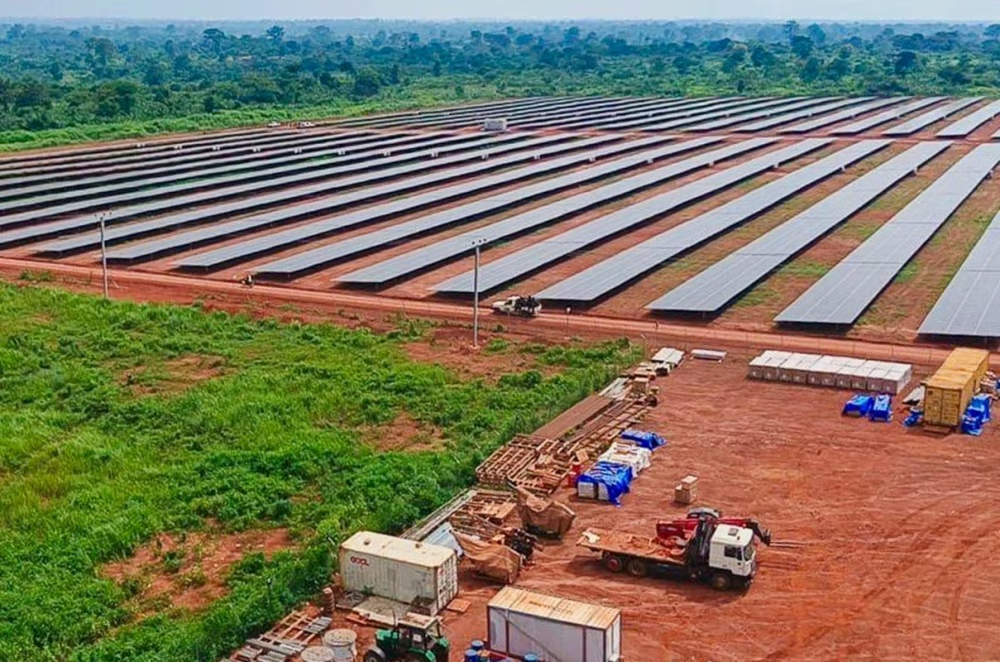

À Bimbo, dans la banlieue de Bangui, les derniers préparatifs battent leur plein. Ce vendredi 7 août, le président Faustin-Archange Touadéra inaugurera la première phase du parc solaire photovoltaïque de Sakaï 2. Quinze mégawatts seront immédiatement injectés dans le réseau national, avant d'atteindre progressivement 60 MW. Pour un pays confronté à des coupures d'électricité récurrentes, cette mise en service représente une étape importante. Elle devrait permettre d'améliorer l'approvisionnement en électricité de Bangui, de Bimbo et des communautés environnantes.
The project is the result of an energy partnership established between Bangui and Abu Dhabi. Its foundation stone was laid on August 14, 2025, by the Head of State. The investment, estimated at $90 million, or nearly 50 billion CFA francs, is fully financed by the Emirati group Global South Utilities Power (GSU). Construction was entrusted to a Chinese company commissioned by GSU under a turnkey contract [the acronym “SSG” in the original text should be verified with the source]. Covering nearly 150 hectares in Bimbo, southwest of the capital, the solar park is among the largest solar infrastructure projects ever carried out in the Central African Republic.
Beyond its scale, Sakaï 2 illustrates the energy transition undertaken by the Central African authorities since Faustin-Archange Touadéra came to power in 2016. At that time, the country had only around 37 MW of installed capacity. According to figures presented by the president in his latest State of the Nation address, this capacity has now reached 140 MW. This progress is the result of both the rehabilitation of existing infrastructure, particularly the Boali 1 and Boali 2 hydroelectric dams, and the commissioning of new facilities, including the Sakaï and Danzi solar power plants, the latter developing a capacity of 25 MW. With the full operation of Sakaï 2, national capacity is expected to reach 200 MW in the medium term. This increase is part of the government’s objective of raising the electricity access rate to 50% by 2030, compared with approximately 17% today. Achieving this goal will require the mobilization of nearly $1.7 billion in investment over the coming years.
Le gouvernement compte sur cette augmentation de l’offre pour renforcer les performances d’Énergie centrafricaine (Enerca), l’entreprise publique chargée de la production, du transport et de la distribution d’électricité. L’objectif est également de soutenir les premiers projets industriels du pays, d’assurer l’approvisionnement en électricité des institutions publiques, des hôpitaux et des ménages, tout en réduisant la dépendance du pays vis-à-vis de l’hydroélectricité et des centrales thermiques, qui sont particulièrement exposées aux risques liés au climat et aux fluctuations des prix des combustibles.
Cette nouvelle centrale s’inscrit donc dans une stratégie plus large visant à diversifier le mix énergétique du pays. En 2024, deux centrales solaires photovoltaïques d’une capacité totale de 40 MW avaient déjà été mises en service. Lors de son dernier discours sur l’état de la nation, Faustin-Archange Touadéra a réaffirmé son ambition d’étendre l’accès à l’électricité à l’ensemble du pays en poursuivant les investissements dans les énergies renouvelables, en développant les réseaux de transport et de distribution, et en mobilisant de nouveaux partenaires techniques et financiers.
Publié à l'origine
Également couvert par Ecomatin
Lire l'article original →